easykemistry

Wednesday, 15 May 2024

PERIODIC TABLE at a glance

PERIODIC TABLE

 The periodic table is an arrangement of all the elements in a particular order.

The periodic law states that the elements on the periodic table are arranged in order of their atomic number.             OR 

The arrangements of the elements on the periodic table is a function of their atomic   number.

  I           II                  III       IV    V    VI      VII    VIII

1H

2He

3Li

4Be

5B

6C

7N

8O

9F

10Ne

11Na

12Mg

13Al

14Si

15P

16S

17Cl

18Ar

19K

20Ca

     → PERIOD  


            ↓

         GROUP

Each horizontal row is called a period

while the vertical column is called a group

The periodic table and the electronic configuration: -The largest principal quantum number of the electronic configuration of an element (the highest positive integer) represents the period to which the element belongs to while the number of electrons in the outermost shell of the configuration represents the group to which the element belongs. For example, 

Given two elements X and Y with the following electronic configuration X=1s22s22p4 and element   Y = 1s22s22p63s2

PERIOD

The largest number (positive integer = principal quantum number) in X is 2 (black bold) (i.e X contains 2 shells) and hence belongs to period 2. The largest number (principal quantum number) in Y is 3 (i.e Y contains 3 shells) and belongs to period 3. Simply put the number of electronic shells in an atom is equivalent to its period in in the Periodic Table.

GROUP

The total number of electrons in the outermost shell of X is 6 i.e  (2+4) and so it belongs to group 6 in the periodic table while Y belongs to group 2 (as it has only 2 electrons in its outermost shell).


TRENDS/ PERIODICITY IN THE PERIODIC TABLE

Periodicity is the variation of properties of elements as you move across a period from left to right or as you go down a group.

These properties are also known a trends in the periodic table and they vary in intensity as you move across the period from group 1 to group 8 and down the group from top to bottom

These properties include: -

ATOMIC RADIUS: - This is the size of an atom. It is the distance between the nucleus of atom and the outermost shell.

It decreases across the period and increases down the group in the periodic table. 

Reason

Across the period as the atomic number increases the charge on the nucleus (nuclear charge) also increases, since the electrons are entering into the same shell, they will experience a greater attraction pulling them towards the center of the atom and hence a decrease in size of the atom across the period. But down the group new shells are being added and hence the atomic size increases automatically.


.


        Size of the atoms decreases as you move across the period but increases down the group

IONIC RADIUS: -For metals their atomic radius is larger than their ionic radius this is because metals ionize by the loss of the outermost or valence electrons and so the ion becomes one shell less than the atom.  Hence the smaller ionic radius.

                                 Atomic Radius vs Ionic Radius

                   
       here the sodium atom is larger in size than the sodium ion due to the loss of the outermost electron/shell. Similarly, the atomic radius of magnesium is smaller than the ionic radius of the magnesium ion

For non-metals their atomic radius is smaller than their ion radius, since non-metals ionize by gaining electros. A slight repulsion occurs between the gained electron and the other electrons in the valence shell. This results to a slight expansion of the ionic radius.     


    here the chlorine atom is smaller than the chloride ion due to the repulsion between the valence electrons and the gained electrons. Similarly, the atomic radius of sulphur atom is smaller the ionic radius of the sulphide ion


IONIZATION ENERGY: - This is the energy required to remove a valence electron from an atom in the gaseous state to form a mole of gaseous ions.

 It increases across the period (due to an increase in the nuclear attraction on the valence electrons across the period) and decrease down the group (as the valence electrons get farther away from the nucleus the become less attracted to the nucleus)

           
         Ionization Energy of the elements on the Periodic Table


ELECTRONAGATIVITY: - This is the tendency of an atom to attract electrons to itself in a molecule. It increases across the period and decrease down the group  


                          The electronegativities of the elements in the Periodic Table


ELCTRON AFFINITY: - This is the energy liberated when an electron enters an atom in the gaseous state to form a mole of negative ion. It increases across the period and decreases down the group.


ELECTRICAL CONDUCTIVITY: - Sodium, magnesium and aluminum are good conductors of electricity because of the ‘sea’ of delocalized electrons they possess. Silicon is a semi-conductor, but not as good a conductor as graphite. All the other elements are electrical insulators.


GENERAL PROPERTIES OF ELEMENTS IN EACH GROUP

1.     GROUP I (s-block elements) (Alkali metals) 

             (Li, Na, K, Rb, Cs and Fr)

i.    They are soft, malleable, and ductile

ii.   They ionize by loss of one electron

iii.  They are good reducing agents

iv.   They are good conductors of heat and electricity

v.    Their densities  generally increase down the group  

vi.    They react with cold water to displace hydrogen gas

            Na(s) + H2O(l) → NaOH(aq) + H2(g)

2.     GROUP II (s-block) (Alkaline earth metals)

         (Be, Mg, Ca, Sr, Ba and Ra)

i.    They ionize by the loss of two electrons 

ii.   They are good conductors of heat and electricity

iii.   They are good reducing agents ( because they lose electrons readily)

iv.    Their melting and boiling points decreases generally down the group

v.      Their densities increases down the group


`3.     GROUP III (p-block)( The boron family)

         (B, Al, Ga, In and Ti)

  i.     Apart from boron all other members of the group are metals 

  ii.   They ionize by losing 3-electrons (common oxidation state is +3)

  iii.   Boiling point decreases down the group (but increases across the period

  iv.   They have high melting points

  vi.   They all form oxides when strongly heated in oxygen

  vii.     Thier reactivity increase down the group

 viii. They tarnish readily in air due to the formation of an oxide layer


4.       GROUP IV (p-block elements) (The Carbon family)

           (C, Si, Ge, Sn and Pb)

 i.      They have oxidation states of +2 and +4 but the +2 becomes more common

 ii.     C (non-metal) Si and Ge (metalloid) have covalent /bonding network within the network while                 Sn and Pb are metallic

 iii.     Their oxides range from acidic (CO2) to amphoteric (SiO2)  

 Iv    


5.      GROUP V (p-block elements) (The Nitrogen family)

                (N, P, As, Sb and Bi)

 i.  Members exhibit various oxidation state but as you go down the group the +3 

oxidation state becomes predominant

 ii.     There is a gradual change in the properties of the members of the group moving from individual or single molecules (N and P) to covalent networks (As and Sb) to metal (Bi)

6.       GROUP VI (p-block)( The Oxygen family)

 The elements in this group and their electronic configuration are shown below

Oxygen = 8: - 1s2 2s2 2p4

Sulphur = 16: - 1s2 2s2 2p6 3s2 3p4

Selenium= 34: - 1s2 2s2 2p6 3s2 3p6 3d10 4s2 4p4

Tellurium = 52: - 1s2 2s2 2p6 3s2 3p6 3d10 4s2 4p6 4d10 5s2 5p4

Polonium = 84: - 1s2 2s2 2p6 3s2 3p6 3d10 4s2 4p6 4d10 5s2 5p6 5d10 5f14 6s2 6p4

General Properties
i.  They are known as oxygen family,

ii. They are all non -metals

iii. They ionize readily by gaining two electrons to form divalent negative ions.

vi. They are good oxidizing agent (because they readily accept electrons)

v. They do not react with Water but oxygen combine directly with hydrogen to form water.

vi. They do not conductor electricity

vii. They are electro-negative   

vii. They electrons acceptor


7.      GROUP VII: - (p-block) (Halogens)

i.  They ionize by gaining one electron

ii.  They are good oxidizing agents

iii.  They are coloured

         * Florine is yellowish 

         * Chlorine is greenish yellow 

         * Bromine is reddish-brown 

         * Iodine is violet

iv.  They dissolve in water to produce acids 

8.        GROUP VIII or 0 (Noble gases) (rare gases) (inert gases)

             (He, Ne, Ar , Kr, Xe, Rn)

i.  They exist freely as monoatomic molecules in the atmosphere, 

ii. They have no bonding electrons in the outermost shell.

iii. They are non-reactive elements, because their valence shell is completely filled.

iv. They exhibit similar properties among themselves.

v. They bear no resemblance to the halogens that come before them and the alkali metals that come after them. 

vi. Their melting and boiling points increase down the group

 vii. Their ionization energy decreases down the group from helium to radon.


TRANSITION METALS: (d-block elements)

     Transition metals are metals that have partially filled d-orbitals. These elements lie between group 2 and 3 from period 4 in the periodic table. They are metals with special properties. 

  Characteristics of transition elements

i. They have variable oxidation states

ii. They form complex ions

iii.  They form coloured ions

iv.  They are paramagnetic

 v. They are mainly used as catalysts


LANTHANIDES AND THE ACTINIDES


OBJECTIVE QUESTIONS 
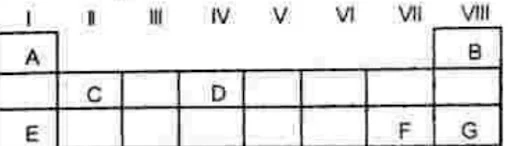
  Use the following portion of the periodic table to answer questions 1 to 3


1. Which of the letters indicate elements which exist as diatomic gases.
a).  B and G
b).  A and  F
c).  C and A
d).  A and E

2. Which of the letters represents an alkaline earth metal?
a).  F
b).  E
c).  D
d).  C

3. Which of the following pairs of letters denotes elements containing the same number of electrons in their outermost shells?
a).  C and D
b).  E and F
c).  B and G
d). A and B

4. An element X has electronic configuration 1s22s22p63s23p64s2. To which group of the periodic table does X belong?

(a). I   (b). II           (c). III           (d). IV


5. Which of the following sets of elements is arranged in order of increasing first ionization energy?

a). 11Na, 3Li, 19K, 37Rb

b). 37Rb, 19K, 3Li, 11Na

c).  3Li, 19K, 11Na, 37Rb

d). 37Rb, 19K, 11Na, 3Li


6. Elements which belongs to the same group in the periodic table are characterized by
a). difference of +1 in the oxidation numbers of successive members 
b). Presence of the same number of outermost electrons I the respective atoms
c). difference of 14 atomic mass units between successive members 
d). presence of the same number of electron shells in the respective atoms.


7. Which of the following electronic configuration represents that of a noble gas 
a). 2,8,8,2
b). 2,8,2
c). 2,8
d). 2,6

8. Which of the following pairs of species contains the same number of electrons [ 6C, 8O, 10Ne, 11Na, 12Mg 13Al, 17Cl]

a). Mg2+ and Al3+

b). Cl- and Ne

c). Na+ and Mg

d). C and Cl-


9. Which of the following statements about rare gases are correct? 

I. Their outermost shells are fully filled.    II. They are generally unreactive.    III. Their outermost shells are partially filled.    IV. They lone pairs of electrons in their outermost shell.

a).  I and II only 

b). II and III only

c). I, II and III only

d). I, II, III and IV


10. How many electrons are in the ion F- ? [199F]

a). 8      (b) 9      (c). 10      (d) 19

11. Which of the following of properties of elements generally increase down a group in the periodic table?
a). Electron affinity 
b). Electronegativity
c). Ionic radius 
d). Ionization energy

12. In which of the following atoms is the ionic radius larger than the atomic radius?        [11Na, 12Mg, 13Al, 17Cl]

a). Aluminum

b). Chlorine

c). Magnesium

d). Sodium

13. Which of the following properties is characteristics of the halogens?

a). Ability to accept electrons readily.

b). Ability to donate electrons readily.

c). Ability to form basic oxides. 

d). Formation of coloured compounds.

14. 


THEORY QUESTIONS 

1. The electronic configuration of five elements represented by the letters P, Q, R, S and T are indicated below

P --- 1s22s22p2

Q --- 1s22s22p4

R --- 1s22s2p6

S --- 1s22s22p63s2

T --- 1s22s22p63s23p5

 Without identifying the elements, state which of them

i).  Belongs to group VI in the periodic table

ii).  Is strongly metallic in character

iii).  Readily ionizes by gaining one electron

iv).  Contains two unpaired electrons in the ground state atom.

v).   Readily loses two electrons during chemical bonding

vi).  Does not participate readily in chemical reactions

vii).   Is an s-block element

bi). Copy and complete the table below as appropriate

Particle

Number of Protons

Number of Electrons

Number of Neutrons

11H

1

1

2713Al3+

168O

8

ii). Give the reason why atomic radius increases down a group in the periodic table but decreases from left to right.

iii). State three properties of transition element. [waec]


2. The electronic configuration of atoms of elements A, B, C and D are given as follows

a). 1s22s22p2

b). 1s22s1

c).  1s22s22p6

d). 1s22s22p1

ai.  Arrange the elements in order of increasing atomic size, giving reason

ii).  State which of the elements

  I. is divalent 

II. Contains atom with two unpaired electrons in the ground state.

III). Readily loses one electron from its atom during chemical bonding

IV)  Belongs to group III in the Periodic Table.


2(a)(i). List three properties of elements which increases generally across a period in the periodic table. 

(ii). Explain briefly why there is general increase on the first ionization energies of the elements across the period in the periodic table 

Monday, 13 May 2024

ISOMERISM at a glance


ISOMERISM IN ORGANIC COMPOUNDS

Isomerism is defined as the occurrence of two or more compounds with the same molecular formular but different molecular structures. 

The different molecular structures are known as Isomers.

Isomers may belong to the same homologous series ( having the same functional group) or may belong to different homologous series (having different functional group)

Isomers with the same functional group, (i.e. belonging to the same homologous series) have similar chemical properties while isomers having different functional group (i.e. belonging to different homologous series) have different physical and chemical properties.

Example:- the formula C2H6O has two isomers 

1. Ethanol an Alkanol with molecular formula CH3CH2OH has a melting point of 78 degree celçius and is a liquid at room temperature 

     H    H
      |      |
H--C--C--OH
      |      |
    H.   H

and 

2. an Alkoxy compound with molecular formula CH3OCH3 which is a gaseous at room temperature

      H       H
      |         |
H--C--O--C--H
      |         |
      H       H

TYPES OF ISOMERISM

(i) Structural isomerism

(ii) Stereo or geometric Isomerism

(iii) Optical isomerism


(I) STRUCTURAL ISOMERISM

This is the occurrence of two or more compounds with the same molecular formula but different molecular structures 

TYPES OF STRUCTURAL ISOMERISM

(a) Chain isomerism: in this case, the isomer differs in the way the carbon atoms are arranged in the molecule. Eg

 CH3CH2CH2CH3  CH3CHCH3   
n-butane                                   |                                                                   
                                              CH3  
                            2-methylpropane (isobutane)

(‘n’ stands for the normal compound while ‘iso’ means the isomer of the normal compound).

NOTE: - Isomerism begins from the 4th member of the alkane homologous series, that is, butane, and as the number of carbon atoms increases the number of isomers also increases. For example, butane has two isomers normal-butane and 2-methyl propane, pentane (C5H12) has three isomers:  n-pentane, 2-methylbutane and 2,2-dimethylpropane.            

  I.  CH3CH2CH2CH2CH3.  (n-pentane)

              CH3
              |
II.  CH3CHCH2CH3  (2-methylbutane)


III.              CH3
                    |        
          CH3-C-CH3
                    |
                  CH3        2,2-dimethylpropane

Three isomers for pentane 

Another example is hexane (C6H14)

I.  CH3CH2CH2CH2CH2CH3

               n-hexane


              CH3
              |
II.  CH3CHCH2CH2CH3    2-methylpentane

III.                        CH3
                              |
              CH3CH2CHCH2CH3          3-methylpentane

                   CH3
                      |
IV.      CH3CCH2CH3    2,2-dimethylbutane
                  |
                  CH3


                  CH3
                    |
V.      CH3CHCHCH3    2,3-dimethylbutane
                        |
                      CH3  

Hexane has 5 isomers 

(b) position isomerism: Position isomers are those that have a substituent in different position on the same carbon skeleton. Example

                CH3CH2CH2OH             CH3CHCH3
                    propan-1-ol                             |
                                                                    OH
                                                             propan-2-ol

(c) Functional Group isomerism: These are isomers having the same molecular formular but different functional groups. They belong to different homologous series.

e.g.
                      H
                    /
(i)  CH3CH2C                          CH3-CCH3
                    \\                                ‖  
                      O                              O
     Propanal  (an aldehyde)       propan-2-one (a ketone)

(ii) CH3CH2OH                                  CH3-O-CH3 

      Ethanol  ( Alkanol)                Methoxymethane (dimethyl ether) (Alkoxy compounds)

(2) STEREO ISOMERISM OR GEOMETRIC ISOMERISM

In this type of isomerism, compounds have the same molecular formular but differ only in the way their atoms are arranged in space.

TYPES   STEREO ISOMERISM

(a) Geometrical isomerism: This type of isomerism is found in compounds having either a double bond, triple bond or a ring structure. These multiple bonds prevent the free rotation about a carbon=carbon atom. that is, the carbon atoms are not cylindrically symmetrical. There are two forms of geometric isomers, the Cis and Trans isomer. For example, but-2-ene has two geometric isomer which are trans-but-2-ene and cis-but-2-ene as shown below.

when naming geometric isomers, you look at the substituents, where the substituents (group other than Carbon atoms) are on the same side of the double bond, that isomer is named the Cis isomer and when the substituents are on opposite sides of the double bond, we put a trans- isomer, but the names are the same

   H               CH3                H             H         
        \           /                                   \         /
          C=C                                       C=C
        /         \                                    ∕         ∖
  CH3          H                              CH3       CH3

Trans-but-2-ene                          Cis-but-2-ene


      H          Br                 H           H
        \         /                         \        /
          C=C                            C=C
        /       \                          /      \  
  Br              H                    Br      Br
Trans-1,2-dibromoethene       Cis-1,2-dibromoethene                    

   C1OOH.  C4OOH              H           COOH
      \           /                             \         /      
        C2=C3                              C=C   
      ∕         ∖                            /        \
COOH       H                      H             H
Trans-butenedioic acid            Cis-butenedioic acid


(b) Optical isomerism: Optical isomers   are isomers that have the same molecular and structural formular but cannot be superimposed on each other. In other words, an optical isomer is one which is not super-imposable on its mirror image. An optical isomer has at least one carbon atom which has four different groups or atoms attached to it. Such a carbon atom (surrounded by four different atoms /group) is called chiral carbon or chiral center. E.g. 2-hydroxylpropanoic acid (Lactic acid).


                           CH3
                            |
             HO — *CH
                            |
                           COOH

                  The Asterix C-atom is called a chiral C-atom because it is surrounded by four (4) different groups.

            In glucose, there are several chiral carbon atoms.

                                          H
                                          ∣
                                          C = O
                                          |
                                H — *C —OH
                                            |
                              OH —*C —H
                                            |
                                H — *C— OH
                                          |
                                H —*C —OH
                                          |
                                H — C—H
                                          |
                                          OH

Optical isomers are also called Enantiomers.

Isomers that belong to the same homologous series (same functional group) have similar chemical properties but may have different physical properties. But isomers which belong to different homologous series (different functional group) have different chemical and physical properties.


OBJECTIVE QUESTIONS 

1. Isomerism is the phenomenon in which compounds have

A. same molecular mass only

B. same empirical formula only

C. same molecular formula but different structures

D. different molecular formula but same structure

2. Which of the following pairs are isomers?

A. CH₄ and C₂H₆

B. C₂H₆ and C₃H₈

C. C₄H₁₀ and C₄H₁₀

D. C₂H₄ and C₂H₆

3. Butane and 2-methylpropane are examples of

A. position isomers

B. functional isomers

C. chain isomers

D. geometric isomers

4. The two main classes of isomerism are

A. structural and stereoisomerism

B. chain and position

C. optical and functional

D. alkane and alkene

5. Which compound shows chain isomerism?

A. C₂H₆

B. C₃H₈

C. C₄H₁₀

D. CH₄

6. Intermediate Level

Position isomerism occurs due to different

A. molecular formula

B. carbon chain length

C. functional groups

D. positions of functional group or substituent

7. Ethanol and dimethyl ether are

A. chain isomers

B. position isomers

C. functional group isomers

D. optical isomers

8. Which of the following shows functional isomerism?

A. Propane and propene

B. Ethanol and ethanoic acid

C. Propanal and propanone

D. Butane and butene

9. Geometric isomerism is also known as

A. structural isomerism

B. optical isomerism

C. cis–trans isomerism

D. functional isomerism

10. Which compound can show geometric isomerism?

A. Ethane

B. Propane

C. But-2-ene

D. Methane

11. Which of these has the highest number of chain isomers?

A. C₃H₈

B. C₄H₁₀

C. C₅H₁₂

D. C₂H₆

12. Optical isomerism is caused by

A. double bonds

B. presence of aromatic ring

C. chiral carbon atom

D. branching

13. The pair CH₃CH₂CHO and CH₃COCH₃ are

A. chain isomers

B. position isomers

C. functional isomers

D. geometric isomers

14. Which statement is true about isomers?

A. They always have the same boiling point

B. They always have identical properties

C. They may have different physical and chemical properties

D. They must belong to different homologous series

15. The number of structural isomers for C₄H₈ (alkenes only) is

A. 1

B. 2

C. 3

D. 4


THEORY QUESTIONS 

1.(a)(i)Define isomerism.

(ii). What are isomers?

(iii). State two differences   between structural and stereoisomerism.

1(b)(i). Explain chain isomerism with one example.

(ii)Explain position isomerism with one example.

(iii). What is functional group isomerism?

1(c)(i). Define geometric isomerism.

State the condition necessary for geometric isomerism.

What is optical isomerism?

Give two examples of compounds that show functional isomerism.

Structured Questions

(a) Define structural isomerism

  (b) List three types of structural isomerism

  (c) Give one example each

(a) What is chain isomerism?

  (b) Draw the structural formulas of the isomers of C₄H₁₀

(a) Explain functional isomerism

  (b) Show the structures of ethanol and dimethyl ether

(a) Distinguish between cis and trans isomers

  (b) Use but-2-ene to illustrate

Draw and name all the structural isomers of C₅H₁₂.

Long Essay Questions


(a) Define isomerism

(b) Describe the different types of structural isomerism

(c) Give two examples for each type


Explain geometric isomerism using suitable diagrams and discuss its importance in chemistry.


Write short notes on:

(i) Chain isomerism

(ii) Position isomerism

(iii) Functional group isomerism

(iv) Optical isomerism


List the structural isomers of C₄H₈ and classify them.


Describe the differences between structural and stereoisomerism with examples.

Friday, 19 April 2024

HYDROCARBONS at a glance

Organic Chemistry is the study of Carbon and its compounds.

Organic compounds are compounds containing Carbon, hydrogen and any one or two other elements like Sulphur, Nitrogen, Oxygen, Phosphorus and even metals like Sodium and potassium.


 General Properties of Organic Compounds 

1.The solid ones have low melting and low boiling points.

2. They are soluble in non-polar solvents.

3. They are thermally unstable ( i.e easily decompose/ breakdown on heating)

4. They combustible

5. They are mostly covalent in nature.


              HYDROCARBONS

Hydrocarbons are compounds containing only two elements, that is, Hydrogen and Carbon.

There are three main families of hydrocarbons 

****The Alkanes 

***

*The Alkenes and 

****The Alkynes 


Sources of hydrocarbons


There are three main sources of hydrocarbons, 

i. Crude oil or petroleum

ii. Natural gas 

iii. Coal


I. Crude oil/petroleum: - Crude oil is a viscous dark liquid that is found in deposits underground. It is formed from animal remains and marine vegetation, algae e.t.c when these are subjected to pressure, heat and bacterial activity they gradually change to this dark viscous liquid known as crude oil. 


Crude oil exploration and drilling 


Crude oil-bearing rocks and areas are located and explored by the following processes.

i. Taking an aerial photograph of the place. 

ii. Examining and testing the surface rocks.

iii. Drilling large holes/core into the ground 

iv. Exploding dynamite in the deep holes drilled into the earth's crust taking recordings and reflections of shock waves resulting from the explosions in the rocks.


II. Natural gas: - Natural gas is a naturally occurring hydrocarbon mixture composed mainly of methane (CH4 about 65% -90%)). Along with methane are other hydrocarbons like ethane, propane and butane. 


It is formed from the decomposition and compression of organic matter, like dead plants and animals, over thousands of years and is usually found in deep underground deposits.


It is extracted from these underground deposits (reservoirs) by drilling pipes into the reservoirs. It is then separated and purified into its various components by fractional distillation.


Uses

i. it is used mainly for heating as fuel,

ii. it is used for generating electricity 

iii. it used as fuel for transportation in the form of liquified natural gas 

Even though we consider natural gas as a relatively clean fossil fuel, its extraction, transportation and various uses can still affect our environment (such as water pollution, methane emissions and land disturbance). 

III. Coal: - Coal is a solid fossil fuel that is mainly composed of carbon, as well as various amounts of other elements such as hydrogen, oxygen, sulfur, and nitrogen (see carbon and its compounds)


Fractional Distillation Of Petroleum

Unless it is refined, crude oil will just be a viscous liquid with very limited use. But when it undergoes fractional Distillation, it is separated into various compounds.


Fractions from fractional Distillation of Petroleum

Table: -showing various petroleum fractions and their uses


Fractions

Number of C-atoms

Uses

1.

Petroleum gas 

C1 - C4

Used mainly as fuel and manufacturing of other organic compounds like chloromethane

2.

Ether

C4 – C6

Used as solvents

3.

Petrol

C7 -C10

Used mainly as fuel for motor car engines

4

Kerosene

C10 – C18

Fuel for cooking, for lighting and used for jet engines

5

Diesel oil

C18 – C25

It is used as a raw material for cracking process, used as fuel for diesel engines

6

Lubricating oils

C20 – C35

Used for

i. oiling / lubricating moving parts of machines, engines and generators

ii. Raw material for making candles, hair cream and body creams products

7.

Bitumen

Above C35

Used for road construction


Classification of Hydrocarbons

Hydrocarbons are classified into 

I. Aliphatic and

II. Aromatic Hydrocarbons


ALIPHATIC HYDROCARBONS: - These are straight chain, branched chain or cyclic hydrocarbons that are saturated or unsaturated. 

Examples of aliphatic hydrocarbons are (CH3CH2CH3) propane, (CH3CH2CH=CH2) butane, pentyne CH3CH2CH2C≡CH)


Straight Chain hydrocarbons

        H   H   H
        ׀    ׀      ׀ 
H – C – C – C −H
        ׀     ׀      ׀
       H     H   H
Propane


      H  H   H  
      ׀    ׀     ׀     
H−C – C – C= C– H
      ׀      ׀      ׀
     H     H    H
Butene


       H    H  H
        ׀     ׀     ׀
H – C – C– C –C ≡ C –H
        ׀    ׀    ׀      
        H  H   H

Pentyne


Branched chain hydrocarbon

 
       H    H    H                                          
       ׀      ׀      ׀
H− C – C – C −H
       ׀            ׀       
      H          H
     H – C – H
             ׀
            H
 
2-methyl propane


Cyclic hydrocarbon
             H
              ׀
              C
              ∕ \
H − C   −   C – H

Cyclopropane


AROMATIC HYDROCARBON: - These are hydrocarbons that contain the benzene ring (C6H6) in its structure. Aromatic Hydrocarbons are unsaturated.

benzene

Terminologies in Organic Chemistry.


I. CATENATION- this is the ability of an element to form single and multiple bonds with itself and other elements.


2. OCTANE NUMBER: - This is the measurement of the efficiency of combustion of petrol in car engines.

It is based on the proportion of branched chain alkanes to straight chains in a given fuel.

For instance, a sample of petrol that contains a high proportion of normal (straight chain) heptane than 2,2,4 trimethylpentane has a low octane number of below 50.


         3. HYBRIDIZATION: - This is the mixing of orbitals to get the same number of hybrid orbitals.

4. HOMOLOGOUS SERIES: - This is a family of organic compounds that conforms to a general molecular formular, and successive members differs by a -CH2- group.

Examples of homologous series include the alkanes, alkenes and alkynes

Characteristics of a Homologous Series 

i. Members differs by a -CH2- group

. Members have the same general molecular formular

iii. Members have similar chemical properties 

iv. Members have the same general method of preparation

v. There is a gradual change in the physical properties of members as you go down the group.


ALKYL GROUP: - This is a homologous series of hydrocarbons formed by the loss of a hydrogen atom by a corresponding alkane.

     The following table shows the first five alkyl members and their corresponding alkane.

Alkyl group 

Corresponding Alkane

Formula

CH3

CH4

       H    
        ׀     
H – C –
        ׀    
       H  

C2H5

C2H6


      H    H    
        ׀     ׀     
H – C – C –
        ׀     ׀    
       H    H  

C3H7

C3H8


       H   H   H
        ׀     ׀     ׀ 
H – C – C – C −
        ׀     ׀      ׀
       H     H  

C4H9

C4H10


        H   H    H   H
        ׀     ׀      ׀     ׀
H – C – C – C – C −
        ׀     ׀      ׀     ׀
       H    H    H   H


C5H11

C5H12

         H   H   H   H   H
        ׀     ׀      ׀     ׀     ׀
H – C – C – C – C – C −
        ׀     ׀      ׀     ׀     ׀
       H    H   H    H   H

The alkyl groups are generally represented by the letter R


FUNCTIONAL GROUP: - A functional group is an atom, a bond or a group of atoms that is present in all the members of a homologous series, and it determines the chemical properties of the family.

The table below shows some functional groups and their names as sufixes and prefixes


Functional groups

Name as Suffix

Name as Prefix

−OH

R-OH


      -Ol

Hydroxy-

−        COOH

             O   
          ∕∕
 — C
        ∖
          H 


      -Oic acid


  -


−COOR

           O
        ∕
  − C
        \
         OR


Alkanoate


   -


− CONH2

          O
       ∕
 − C
       \
         NH2


-amide


   -


−C=O

       O
     ∕∕
−C
    \


-One


-oxo-


-CHO

     O
    ∕∕
−C
     \
      H


-al


Oxo-

−NH2

   −N 


-amine


amino

−CN

  −C≡N


 -carbonitrile


cyano


−Cl


-Chloro


 −Br


-bromo


 −I


-iodo


   −


       -ane


   =


       -ene


   ≡


      -yne


 The three main hydrocarbons (that is, the alkane, the alkene and the alkyne are discussed separately in different posts. 


 OBJECTIVE QUESTIONS 

Here are 20 WAEC & NECO–standard objective (multiple-choice) questions on Hydrocarbons, suitable for exams and revision:


Objective Questions on Hydrocarbons

1. Hydrocarbons are organic compounds that contain
A. carbon and oxygen only
B. carbon, hydrogen and oxygen
C. carbon and hydrogen only
D. hydrogen and oxygen only


2. Which of the following is a saturated hydrocarbon?
A. Ethene
B. Ethyne
C. Benzene
D. Ethane


3. The general formula of alkanes is
A. CₙHₙ
B. CₙH₂ₙ
C. CₙH₂ₙ₊₂
D. CₙH₂ₙ₋₂


4. Which hydrocarbon undergoes substitution reaction?
A. Alkanes
B. Alkenes
C. Alkynes
D. Aromatic hydrocarbons


5. Ethene belongs to the homologous series known as
A. alkanes
B. alkenes
C. alkynes
D. aromatics


6. Which of the following is an unsaturated hydrocarbon?
A. Methane
B. Propane
C. Butene
D. Pentane


7. The functional group present in alkenes is
A. C–C
B. C≡C
C. C=C
D. –OH


8. Which reagent is used to test for unsaturation in hydrocarbons?
A. Limewater
B. Bromine water
C. Fehling’s solution
D. Sodium hydroxide


9. The process of breaking large hydrocarbon molecules into smaller ones is called
A. polymerization
B. fermentation
C. cracking
D. substitution


10. Which hydrocarbon has the molecular formula C₂H₂?
A. Ethane
B. Ethene
C. Ethyne
D. Benzene


11. Members of a homologous series have the same
A. molecular mass
B. physical properties
C. chemical properties
D. number of carbon atoms


12. Which of the following hydrocarbons is aromatic?
A. Ethane
B. Ethene
C. Ethyne
D. Benzene


13. The main source of hydrocarbons is
A. coal
B. natural gas
C. petroleum
D. water


14. Which hydrocarbon will decolourize bromine water?
A. Methane
B. Ethane
C. Propane
D. Ethene


15. The homologous series with general formula CₙH₂ₙ₋₂ is
A. alkanes
B. alkenes
C. alkynes
D. aromatics


16. What type of reaction occurs when ethene reacts with hydrogen?
A. Substitution
B. Addition
C. Elimination
D. Oxidation


17. Which property generally increases down a homologous series?
A. Chemical reactivity
B. Solubility in water
C. Boiling point
D. Unsaturation


18. The complete combustion of hydrocarbons produces
A. carbon monoxide and water
B. carbon dioxide and water
C. carbon and water
D. hydrogen and carbon dioxide


19. Which hydrocarbon is used in the manufacture of polythene?
A. Methane
B. Ethane
C. Ethene
D. Propane


20. Which statement about hydrocarbons is correct?
A. All hydrocarbons are unsaturated
B. All hydrocarbons contain oxygen
C. Hydrocarbons can be saturated or unsaturated
D. Hydrocarbons do not burn in air


1. Octane number is highest in petrol containing a high proportion of

a. heptane 

b. octane

c. 2-methylpentane

d. 2,2,4-trimethylpentane


2. Compounds containing only hydrogen and carbon are called 

a. hydrocarbons

b. alkanes 

c. isomers 

d. organic 

3.


Sunday, 14 April 2024

Rates of Chemical Reactions

During a chemical reaction, reactants collide with one another to form products, and the formation of these products do not occur at the same rates. Hence 

Rate of a chemical reaction can be defined as the number of moles of reactants that are converted, or products that are formed per unit time.

Mathematically 

Rate =      mass in grammes 
                      time taken

For instance, if 6g of zinc metal is placed in dilute tetraoxosulphate (VI) acid and it takes 3 mins to completely react, then the rate of chemical reaction is given by. 

Rate =      6g     = 2g/mins
                3min
That is, 2g of the zinc was converted to ZnCl2 per minute 

Factors used for Measuring Rates of Reaction
The rate of a chemical reaction can be measured or can be determine by any one of the following.
i.   decrease in mass of reactants.
ii.  increase in volume of a gaseous product 
iii. change in pH
iv. change in colour intensity 
v. Change in pressure
 
These are all measurable factors.

 Factors Affecting the Rate of Chemical Reactions.
The following factors will a reaction to be fast or slow.

i. Nature of reactants
ii. Temperature
iii.. Concentration 
iv. Pressure 
v.  Presence of light
vi. Surface area 
vii. Presence of a catalyst

Before we discussed how each of these factors will affect the rate of a chemical reaction. It is important that we understand the concept of collision theory.

Collision theory assumes that for a chemical reaction to occur, there must be Collision between reactants particles, and these Collisions must be effective.

A collision is said to be effective when it leads to formation of products

What this concept is actually implying is that all collisions do not lead to the formation of a product, only the ones that are effective. So, the various factors that affect chemical reactions are factors that actually increase the number of effective collisions.


I. Effect of Nature of reactants: - this is one of the factors that affects the rate of a reaction, since different elements/ compounds behave differently.
The reactivity of metals varies as you go down the activity series and so when metals react with acids for example the reactions are not the same.
Example by virtue of their nature (their high reactivity) sodium and potassium will react explosively with dilut acids while metals like zinc and iron will react moderately with dilute acids.

II. Effect of Temperature: - An increase in temperature will cause reactants particles to gain more kinetic energy leading to an increase in effective collision and hence, an increase in the rate of reaction. An increase in temperature will also lead to an increase in the energy of the system.

III. Effect of Concentration: - An increase in the concentration of the reactants will lead to an increase in the number of reactants per unit area (the reactants becomes closer) thus, leading to overcrowding and increase in the effective collision of the reactants and hence an increase in the rate of the reaction.

IV. Effect of pressure: - An increase in pressure will lead to a decrease in volume that is, a decrease in the intermolecular space between the reactants particles leading to an increase in the effective collision and hence an increase in the rate of reaction. And vice versa 

V. Effect of presence of light: - Some reactions are photochemical, that is, affected by light. When such reactions are exposed to light the reactants, particles become more activated and collide more increasing the number of effective collisions and hence an increase in the rate of reaction.

VI. Effect of a catalyst: - A catalyst increases the rate of a reaction by creating a different pathway with a lower activation energy.

ACTIVATION ENERGY: see definition in chemistry.
  For a collision to be effective, the reactants must possess the minimum amount of energy needed to overcome the energy barrier (activation energy for the reaction) for that reaction. The higher the activation energy, the slower the rate of reaction; positive catalyst helps to lower the activation energy.


 Energy Profile Diagram 

Energy profile diagram is a diagram / graph that shows the pathway of a chemical reaction. whether the reaction is exothermic or endothermic.


                                          Figure1: Energy profile diagram of an exothermic reaction. 
The reactants have higher energy than the products, showing that heat is released during the reaction. The peak represents the activated complex, while Ea is the activation energy and ΔH is the heat of reaction.


                                         Figure2: Energy profile diagram of an endothermic reaction.
 The products have higher energy than the reactants, indicating that heat is absorbed during the reaction. The highest point is the activated complex, Ea is the activation energy, and ΔH represents the heat of reaction.

 Rate Curve

A rate Curve is the graph which shows the rate of a reaction. It is a graph of reaction against time.( that is, change in concentration against time, decrease in mass against time, e.t.c) 
The slope or the gradient of the curve is steep at the beginning because the reaction is fastest ( since  , it becomes less steep as the reaction progresses and slows down, then it finally becomes horizontal. 
The point at which the graph becomes horizontal indicates the end point of the reaction, when one of the reactants is completely used up


figure 1:  A typical rate curve showing how the mass of a reactant decreases with time during a chemical reaction. The steep part of the curve shows a fast reaction at the beginning, while the flatter part shows the reaction slowing down as the reactants are used up.


Figure 2: A graph showing how the volume of a gaseous product increases with time during a chemical reaction. The curve rises steeply at first, indicating a fast rate of gas production, and then levels off as the reaction nears completion.


ORDER Of REACTIONS
1. A first-order reaction is a chemical reaction in which the rate depends on the concentration of only one reactant raised to the power one.

In simple terms:
The speed of the reaction is directly proportional to the concentration of one reactant.

           Rate ɑ [A]
   or

           {Rate} = k[A]

Where:

  • (A) = reactant

  • (k) = rate constant

What this means

If the concentration of the reactant is doubled, the rate of reaction also doubles.
If the concentration is halved, the rate is halved.

Example

The decomposition of hydrogen peroxide:

H2O2 → H2O + O2

The rate depends only on the concentration of (H2O2), so it is a first-order reaction

A first-order reaction has a constant half-life — the time taken for half of the reactant to be used up does not change, no matter the starting concentration.

Example of a First-order reaction)

The half-life of a first-order reaction is 10 minutes.
If the initial concentration of the reactant is 80 mol dm⁻³, find the concentration after 20 minutes.

Solution

For a first-order reaction, the half-life is constant.

In 10 minutes → concentration becomes half

                                                         80 →40

In another 10 minutes (total = 20 minutes) → it halves again

40 → 20

Answer

The concentration after 20 minutes is 20 mol dm⁻³.

A second-order reaction is a chemical reaction in which the rate depends on the square of the concentration of one reactant, or on the product of two reactants.

It can be written as:

                                                Rate = k[A]2
                             or 
                                                        Rate = k[A][B]

what this means is that

  • If the concentration of a reactant is doubled, the rate increases four times.

  • If the concentration is tripled, the rate increases nine times.

Simple example

The reaction between nitrogen dioxide molecules:

                           2NO2 →2NO + O2

This is second order because the rate depends on ([NO2]2).

Another example of a 2nd order reaction is 

The reaction between hydrogen and iodine:


                                H2 + I2 →2HI

This reaction is second order because experiments show that its rate depends on the product of the concentrations of both reactants:

Rate = k[H2][I2]

It means:

  • If the concentration of H₂ is doubled, the rate doubles.

  • If the concentration of I₂ is also doubled, the rate doubles again. So the overall rate becomes four times faster.

The reaction is second order because the rate depends on the concentrations of two reacting substances.


waec/neco keypoint

A second-order reaction does not have a constant half-life — its half-life changes as the concentration changes.


OBJECTIVE QUESTIONS 

1. Which of the following best describes the rate of a chemical reaction?

A. The amount of heat produced
B. The speed at which reactants are used up
C. The colour change in a reaction
D. The total energy of the reaction

2. Which of the following factors does NOT affect the rate of a chemical reaction?

A. Temperature
B. Pressure
C. Concentration
D. Density

3. An increase in temperature increases the rate of reaction because

A. molecules become heavier
B. molecules move faster and collide more
C. the volume of the gas increases
D. the pressure decreases

4. Which of the following will increase the rate of reaction between zinc and hydrochloric acid?

A. Using dilute acid
B. Using powdered zinc
C. Lowering the temperature
D. Using large zinc pieces

5. A catalyst increases the rate of a chemical reaction by

A. increasing the temperature
B. creating a different pathway with a lower activation energy
C. increasing the pressure
D. increasing the concentration

6. Which of the following is an example of a catalyst?

A. Copper (II) sulphate
B. Manganese (IV) oxide
C. Sodium chloride
D. Water

7. In a reaction between a solid and a liquid, the rate of reaction is increased by

A. decreasing the surface area of the solid
B. increasing the size of the solid
C. increasing the surface area of the solid
D. reducing the concentration of the liquid

8.  Which of the following will slow down a chemical reaction?

A. Increasing temperature
B. Increasing concentration
C. Adding a catalyst
D. Lowering temperature

9. The rate of reaction between magnesium and dilute hydrochloric acid can be measured by

A. change in colour
B. volume of gas produced
C. mass of magnesium used
D. number of bubbles formed

10. Which graph best represents a fast reaction?

A. One that rises steeply
B. One that rises slowly
C. One that is flat
D. One that slopes downward

11. Which of the following graphs best represents an exothermic reaction?
A. Products higher than reactants
B. Products lower than reactants
C. Reactants and products at same level
D. No activation energy

12. The peak of an energy profile diagram represents the
A. reactants
B. products
C. activated complex
D. catalyst

13. The minimum energy required for a reaction to occur is called
A. enthalpy
B. heat of reaction
C. activation energy
D. reaction rate

14. In an endothermic reaction, the heat of reaction (ΔH) is
A. zero
B. negative
C. positive
D. constant

15. If a reaction produces a gas and the mass of the reaction mixture decreases with time, this is because
A. heat is absorbed
B. gas escapes
C. the solid melts
D. the reaction stops

16. A steep slope on a rate of reaction graph indicates
A. a slow reaction
B. no reaction
C. a fast reaction
D. equilibrium

17. Which of the following will increase the rate of a chemical reaction?
A. Decreasing temperature
B. Removing a catalyst
C. Increasing concentration
D. Decreasing surface area

18. In an exothermic reaction, the products are
A. more energetic than the reactants
B. less energetic than the reactants
C. equal in energy to the reactants
D. unstable

19. The heat energy absorbed or released during a reaction is represented by
A. Ea
B. ΔH
C. K
D. pH

20. On a volume of gas versus time graph, the reaction is complete when
A. the curve is steep
B. the curve is straight
C. the curve becomes horizontal
D. the volume decreases 

21. The rate of a reaction is given by the expression
{Rate} = k[A]^2
If the concentration of (A) is increased from 0.2 mol dm⁻³ to 0.4 mol dm⁻³, how does the rate of reaction change?

A. It doubles
B. It triples
C. It increases four times
D. It remains the same

22. A finely divided form of a metal burn more readily in air than the rod form because the rod has  (a) higher molar mass (b).  smaller surface area (c) protective oxide coating (d) different chemical properties 

THEORY QUESTIONS.

1.(a)(i) Define rate of a chemical reaction?
     ii). mention three factors that can affect the rate of a chemical reaction
     iii). state the collision theory

b).  A sample of carbon is burnt at a rate of 0.50gper second for 30 minutes to generate heat.
    (i). write a balanced equation for the reaction
   (ii). determine the    I. volume of carbon (IV) oxide produced at s.t.p.  II. moles of oxygen used up in the process at s.t.p. [ C= 12.0, O= 16.0, Molar volume Vm = 22.4dm3

c. State how each of the following affects the rate of chemical reactions (i) surface area (ii) catalysts [waec]

2.a(I) What is meant by the rate of chemical reaction? 
(ii). Explain in terms of collision theory, the effect of temperature increase on reaction rate.
(b) When hydrogen peroxide is exposed to air, it decomposes (I) write an equation for the reaction (ii). Outline an experiment to illustrate the effect of a named catalyst on the rate of decomposition. 
(iii).         

3a(i) Sketch an energy profile diagram to show the effect of a catalyst on the reaction rate, given that it is exothermic.
b. The graph below is the ratio curve for the following reaction carried out in an open vessel 

MgCO3(aq) + 2HCl → MgCl2(aq) +H2O(l) + CO2(g)

(i)  For how long the reaction occurred 
(ii) why was there a loss in mass?
(iii) State whether the reaction rate was fastest at the beginning, the middle  or towards the end of the reaction.  Give reason for your answer.
(iv) List three reaction conditions that can affect the slope of the curve.(waec)

4(a)In an experiment, excess 0.050mol/dm3 HCl was added to 10g of granulated zincin a beaker. Other conditions remaining constant state how the reaction rate would be affected in each case if the experiment was repeated using 
(i) 1.0mol/dm3 HCl

(ii) 8.0g of granulated zinc

(iii) 10g of zinc dust 

(iv) a higher volume of 0.5mol/dm3 HCl 

(v) a reaction vessel dipped in crushed ice 

(vi) equal volumes of water and 0.50mol/dm3 HCl.
b. 

5. (a) What is meant by the rate of a chemical reaction?

     (b) State three factors that affect the rate of a chemical reaction.

6. Explain how each of the following affects the rate of a chemical reaction:

(a) Temperature
(b) Concentration
(c) Surface area

7. (a) What is a catalyst?

(b) Give two examples of catalysts.
(c) State two characteristics of a catalyst.

8. A piece of calcium carbonate reacts with dilute hydrochloric acid.

(a) Write the balanced chemical equation for the reaction.
(b) State two ways in which the rate of the reaction can be increased.
(c) Explain one of the ways stated in (b).

9. (a) Explain why powdered zinc reacts faster with dilute hydrochloric acid than a lump of zinc.

 (b) What is meant by activation energy?

(c) How does a catalyst affect the activation energy of a reaction?

10. During a chemical reaction, the volume of gas produced was measured with time.

 (a) What information can be obtained from such a graph?
(b) How can you tell from the graph that the reaction is fast?

11. State two industrial processes where catalysts are used and name  the catalyst used in each case.

 (b) Explain why an increase in pressure increases the rate of reaction between gases.

(12).  (i) Draw the energy profile diagram for the reaction H2(g) + I2(g) → 2HI(g) △H = -13kJmol-1 if the concentration of HI(g) increases from 0.001 to 0.002 mol/dm3 in 80 secs what is the rate of the reaction