PERIODIC TABLE
The periodic table is an arrangement of all the elements in a particular order.
Mendeleev’s Periodic Table (1869): Dmitri Mendeleev created the first widely accepted periodic table. He arranged elements by atomic mass and left gaps for undiscovered elements, predicting their properties accurately.
Modern Periodic Table (1913): Henry Moseley improved the table by arranging elements according to atomic number instead of atomic mass, resolving earlier inconsistencies.
Modern Periodic Law
The Modern Periodic Law states that:
“The physical and chemical properties of elements are a periodic function of their atomic numbers.”
This means:
i. When elements are arranged in order of increasing atomic number, their properties repeat at regular intervals.
ii. Elements in the same group (vertical column) have similar chemical properties because they have the same number of valence electrons.
Arrangement of the first 20 elements
I II III IV V VI VII VIII
|
1H |
|
|
|
|
|
|
|
2He |
|
3Li |
4Be |
|
5B |
6C |
7N |
8O |
9F |
10Ne |
|
11Na |
12Mg |
|
13Al |
14Si |
15P |
16S |
17Cl |
18Ar |
|
19K |
20Ca |
|
|
|
|
|
|
|
↓
GROUP
Each horizontal row is called a period (I - VIII)
while the vertical column is called a group
The periodic table and the electronic configuration: -The largest principal quantum number of the electronic configuration of an element (the highest positive integer) represents the period to which an element belongs to while the number of electrons in the outermost shell of the atom represents the group to which the element belongs to in the periodic table. For example,
Given two elements X and Y with the following electronic configuration
i. X=1s22s22p4 and element
ii. Y = 1s22s22p63s2.
PERIOD
The largest number (positive integer = principal quantum number) in X is 2 (black bold) (i.e X contains 2 shells) and hence belongs to period 2. The largest number (principal quantum number) in Y is 3 (i.e Y contains 3 shells) and belongs to period 3. Simply put the number of electronic shells in an atom is equivalent to its period in in the Periodic Table.
GROUP
The total number of electrons in the outermost shell of X is 6 i.e (2+4) and so it belongs to group 6 in the periodic table while Y belongs to group 2 (as it has only 2 electrons in its outermost shell).
TRENDS/ PERIODICITY IN THE PERIODIC TABLE
Periodicity is the variation of properties of elements as you move across a period from left to right or as you go down a group.
These properties are also known a trends in the periodic table and they vary in intensity as you move across the period from group 1 to group 8 and down the group from top to bottom
These properties include: -
ATOMIC RADIUS: - This is the size of an atom. It is the distance between the nucleus of atom and the outermost shell.
It decreases across the period and increases down the group in the periodic table.
Reason
Across the period as the atomic number increases the charge on the nucleus (nuclear charge) also increases, since the electrons are entering into the same shell, they will experience a greater attraction pulling them towards the center of the atom and hence a decrease in size of the atom across the period. But down the group new shells are being added and hence the atomic size increases automatically.

IONIC RADIUS: -For metals their atomic radius is larger than their ionic radius this is because metals ionize by the loss of the outermost or valence electrons and so the ion becomes one shell less than the atom. Hence the smaller ionic radius.
Atomic Radius vs Ionic Radius

here the sodium atom is larger in size than the sodium ion due to the loss of the outermost electron/shell. Similarly, the atomic radius of magnesium is smaller than the ionic radius of the magnesium ion
For non-metals their
atomic radius is smaller than their ion radius, since non-metals ionize by
gaining electros. A slight repulsion occurs between the gained electron and the other electrons in the valence shell. This results to a slight expansion of the ionic radius.

here the chlorine atom is smaller than the chloride ion due to the repulsion between the valence electrons and the gained electrons. Similarly, the atomic radius of sulphur atom is smaller the ionic radius of the sulphide ion
IONIZATION ENERGY: - This is the energy required to remove a valence electron from an atom in the gaseous state to form a mole of gaseous ions.
It increases across the period (due to an increase in the nuclear attraction on the valence electrons across the period) and decrease down the group (as the valence electrons get farther away from the nucleus the become less attracted to the nucleus)

ELECTRONAGATIVITY: - This is the tendency of an atom to attract electrons to itself in a molecule. It increases across the period and decrease down the group

ELCTRON AFFINITY: - This is the energy liberated when an electron enters an atom in the gaseous state to form a mole of negative ion. It increases across the period and decreases down the group.
ELECTRICAL CONDUCTIVITY: - Sodium, magnesium and aluminum are good conductors of electricity because of the ‘sea’ of delocalized electrons they possess. Silicon is a semi-conductor, but not as good a conductor as graphite. All the other elements are electrical insulators.
GENERAL PROPERTIES OF ELEMENTS IN EACH GROUP
1. GROUP I (s-block elements) (Alkali metals)
(Li, Na, K, Rb, Cs and Fr)
i. They are soft, malleable, and ductile
ii. They ionize by loss of one electron
iii. They are good reducing agents
iv. They are good conductors of heat and electricity
v. Their densities generally increase down the group
vi. They react with cold water to displace hydrogen gas
Na(s) + H2O(l) → NaOH(aq) + H2(g)
2. GROUP II (s-block) (Alkaline earth metals)
(Be, Mg, Ca, Sr, Ba and Ra)
i. They ionize by the loss of two electrons
ii. They are good conductors of heat and electricity
iii. They are good reducing agents ( because they lose electrons readily)
iv. Their melting and boiling points decreases generally down the group
v. Their densities increases down the group
`3. GROUP III (p-block)( The boron family)
(B, Al, Ga, In and Ti)
i. Apart from boron all other members of the group are metals
ii. They ionize by losing 3-electrons (common oxidation state is +3)
iii. Boiling point decreases down the group (but increases across the period
iv. They have high melting points
vi. They all form oxides when strongly heated in oxygen
vii. Thier reactivity increase down the group
viii. They tarnish readily in air due to the formation of an oxide layer
4. GROUP IV (p-block elements) (The Carbon family)
(C, Si, Ge, Sn and Pb)
i. They have oxidation states of +2 and +4 but the +2 becomes more common
ii. C (non-metal) Si and Ge (metalloid) have covalent /bonding network within the network while Sn and Pb are metallic
iii. Their oxides range from acidic (CO2) to amphoteric (SiO2)
Iv
5. GROUP V (p-block elements) (The Nitrogen family)
(N, P, As, Sb and Bi)
i. Members exhibit various oxidation state but as you go down the group the +3
oxidation state becomes predominant
ii. There is a gradual change in the properties of the members of the group moving from individual or single molecules (N and P) to covalent networks (As and Sb) to metal (Bi)
6. GROUP VI (p-block)( The Oxygen family)
The elements in this group and their electronic configuration are shown below
Oxygen = 8: - 1s2 2s2 2p4
Sulphur = 16: - 1s2 2s2 2p6 3s2 3p4
Selenium= 34: - 1s2 2s2 2p6 3s2 3p6 3d10 4s2 4p4
Tellurium = 52: - 1s2 2s2 2p6 3s2 3p6 3d10 4s2 4p6 4d10 5s2 5p4
Polonium = 84: - 1s2 2s2 2p6 3s2 3p6 3d10 4s2 4p6 4d10 5s2 5p6 5d10 5f14 6s2 6p4
The elements in this group include Oxygen, Sulphur, Selenium, Tellurium and Polonium.
1. Every other element except oxygen is a solid at room temperature
2. Metallic property increases down the group. (Oxygen and sulphur are non-metal; selenium and tellurium are metalloid, while polonium is a metal).
3. Oxygen and sulphur exhibit allotropy.
4. With six electrons in their outermost shell. Hence their oxidation number is -2; though sulphur can displays -4 and -6 states in some compounds.
5. Electronegativity decreases down the group. Thus, oxygen is a good oxidizing agent.
6. They are good oxidizing agent (because they readily accept electrons)
7. They do not conductor electricity
8. They do not react with water
7. GROUP VII: - (p-block) (Halogens)
i. They ionize by gaining one electron
ii. They are good oxidizing agents
iii. They are coloured
* Florine is yellowish
* Chlorine is greenish yellow
* Bromine is reddish-brown
* Iodine is violet
iv. They dissolve in water to produce acids
8. GROUP VIII or 0 (Noble gases) (rare gases) (inert gases)
(He, Ne, Ar , Kr, Xe, Rn)
i. They exist freely as monoatomic molecules in the atmosphere,
ii. They have no bonding electrons in the outermost shell.
iii. They are non-reactive elements, because their valence shell is completely filled.
iv. They exhibit similar properties among themselves.
v. They bear no resemblance to the halogens that come before them and the alkali metals that come after them.
vi. Their melting and boiling points increase down the group
vii. Their ionization energy decreases down the group from helium to radon.
TRANSITION METALS: (d-block elements)
Transition metals are metals that have partially filled d-orbitals. These elements lie between group 2 and 3 from period 4 in the periodic table. They are metals with special properties.
Characteristics of transition elements
i. They have variable oxidation states
ii. They form complex ions
iii. They form coloured ions
iv. They are paramagnetic
v. They are mainly used as catalysts
LANTHANIDES AND THE ACTINIDES
OBJECTIVE QUESTIONS
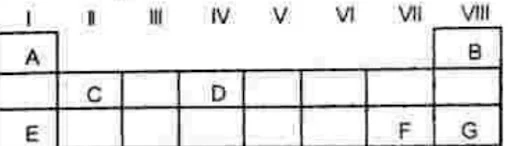
4. An element X has electronic configuration 1s22s22p63s23p64s2. To which group of the periodic table does X belong?
(a). I (b). II (c). III (d). IV
5. Which of the following sets of elements is arranged in order of increasing first ionization energy?
a). 11Na, 3Li, 19K, 37Rb
b). 37Rb, 19K, 3Li, 11Na
c). 3Li, 19K, 11Na, 37Rb
d). 37Rb, 19K, 11Na, 3Li
8. Which of the following pairs of species contains the same number of electrons [ 6C, 8O, 10Ne, 11Na, 12Mg 13Al, 17Cl]
a). Mg2+ and Al3+
b). Cl- and Ne
c). Na+ and Mg
d). C and Cl-
9. Which of the following statements about rare gases are correct?
I. Their outermost shells are fully filled. II. They are generally unreactive. III. Their outermost shells are partially filled. IV. They lone pairs of electrons in their outermost shell.
a). I and II only
b). II and III only
c). I, II and III only
d). I, II, III and IV
10. How many electrons are in the ion F- ? [199F]
12. In which of the following atoms is the ionic radius larger than the atomic radius? [11Na, 12Mg, 13Al, 17Cl]
a). Aluminum
b). Chlorine
c). Magnesium
d). Sodium
13. Which of the following properties is characteristics of the halogens?
a). Ability to accept electrons readily.
b). Ability to donate electrons readily.
c). Ability to form basic oxides.
d). Formation of coloured compounds.
14.
P --- 1s22s22p2
Q --- 1s22s22p4
R --- 1s22s2p6
S --- 1s22s22p63s2
T --- 1s22s22p63s23p5
Without identifying the elements, state which of them
i). Belongs to group VI in the periodic table
ii). Is strongly metallic in character
iii). Readily ionizes by gaining one electron
iv). Contains two unpaired electrons in the ground state atom.
v). Readily loses two electrons during chemical bonding
vi). Does not participate readily in chemical reactions
vii). Is an s-block element
bi). Copy and complete the table below as appropriate
|
Particle |
Number of Protons |
Number of Electrons |
Number of Neutrons |
|
11H |
1 |
1 |
|
|
2713Al3+ |
|||
|
168O |
8 |
ii). Give the reason why atomic radius increases down a group in the periodic table but decreases from left to right.
iii). State three properties of transition element. [waec]
2. The electronic configuration of atoms of elements A, B, C and D are given as follows
a). 1s22s22p2
b). 1s22s1
c). 1s22s22p6
d). 1s22s22p1
ai. Arrange the elements in order of increasing atomic size, giving reason
ii). State which of the elements
I. is divalent
II. Contains atom with two unpaired electrons in the ground state.
III). Readily loses one electron from its atom during chemical bonding
IV) Belongs to group III in the Periodic Table.
2(a)(i). List three properties of elements which increases generally across a period in the periodic table.
(ii). Explain briefly why there is general increase on the first ionization energies of the elements across the period in the periodic table
13 comments:
This is wonderful 😊
Superb
This is very nice😊
Great
👍
Yeah very wonderful 👍
Thank you very much it has been helpful
incredible
incredible
Great thanks so much
Good for learning
Sharp
It really helps
Post a Comment