easykemistry

Thursday, 23 May 2024

EQUILLIBRIUM at a glance

                       EQUILLIBRIUM


EQUILLIBRIUM is said to be established in a reversible reaction when the rate of forward reaction is equally to the rate of backward reaction.

 We can describe equilibrium here as a state where there is no observable change.
In this Chapter we will be looking at Equilibrium in Chemistry and try to explain it as best as we can

Types of Equilibrium
Equilibrium can be Static and Dynamic

I. Static equilibrium: - In static equilibrium there is basically no movement within the system and the substances involved are at the same level. An example of a static equilibrium is when two children on a seesaw are suspended in space.
You will observe that both children suspended in space have the same potential energy. But any slight disturbance and the equilibrium will be lost.

Ii. Dynamic equilibrium: - In dynamic equilibrium, there is actually movements, but the changes are not observable. For example, a child going up an escalator that is actually descending at the same speed as the child, the child would seem to remain at a particular spot even though he is moving up.
Dynamic equilibrium can be grouped into two
I. Physical equilibrium and 
Ii. Chemical equilibrium

I. Dynamic physical equilibrium: -In dynamic equilibrium no new substance is formed (just like a physical change). For example, when sodium chloride is dissolved in water to give a saturated solution, the dissolved crystals will crystallize out of the solution just as undissolved crystals are dissolving into the solution, with these forward and backward reactions occurring at the same rate, we say the saturated solution is in equilibrium. 

  NaCl(s) ⇌ NaCl(aq)

II. Dynamic Chemical Equilibrium: - In this equilibrium system a new substance is formed (just like a chemical change).
An example is the reaction between Nitrogen and Hydrogen to yield Ammonia

N2(g) + 3H2(g) ⇌ 2NH3(g)

In dynamic equilibrium a new substance is formed.

Properties Of a System in Equilibrium
If a system is in equilibrium, then it will possess the following properties

I. The reaction must be a reversible reaction 
Ii. The rate of forward reaction must be equal to the rate of backward reaction 
III. ∆G must be equal to zero. (delta G is the Gibbs free energy)
IV. The equilibrium can be approached from either side of the reaction.
V. The reaction must occur in a closed system.

Factors affecting a system in equilibrium position of a reversible reaction

I. Temperature 
II. Concentration 
III. Pressure
IV. Catalyst
 
Le Chatelier's Principle: See laws and principles

The effect in equilibrium position brought about by a change in any of the factors mentioned above was predicted and may be explained by Le Chatelier's principle 

i. How Temperature Affects equilibrium position of a reversible reaction: - Given a reaction where the forward reaction is exothermic, then the backward reaction will be endothermic.  For such a reaction, an increase in temperature will shift the position of Equilibrium to the left, that is, it will favor the backward reaction on the other hand, a decrease in temperature will favor the forward reaction since it does not require much heat.


How Concentration Affects the equilibrium position of a reversible reaction: - When any one of the reactants in a reversible reaction is increased this will cause the equilibrium position to shift to the right, favouring the forward reaction.   This is because an equilibrium has already been established and adding more reactants will alter that equilibrium, and so according to Le Chatelier's principle the reactants will be quickly used up and be converted to product. 
If the products are removed from the system as they produced, this can also cause the equilibrium to shift to the right.
For example, let us consider the equilibrium reaction of the Haber process, that the reaction between H2 and N2 the produce NH3
 

                    N2(g) + 3H2(g) ⇌ 2NH3(g)

An increase in the concentration of the N2 or H2 will cause the equilibrium position to shift to the right, favouring the forward reaction.


How Pressure Affects the equilibrium position of a reversible reaction: - For Pressure to affect the equilibrium position of a reversible reaction, at least one of the reactants or products must be a gas and the total number of mols (vol.) of the reactants must be different from the total number of mols (vol.) of the product. 

For example, considering the two reactions 

  1. Fe(s) + 4H2O(g) ⇌ Fe2O3 + 4H2(g) 

                  4vol.                 4vol.


         2.  N2O4(g) ⇌ 2NO2(g)


              1vol.        2vol.


Pressure cannot affect the position of equilibrium of equation 1 because the volumes of both the gaseous reactant and gaseous product are the same (i.e. 4vol.)
However, in equation 2. the total volume of reactants is different from the volume of product, so an increase in pressure for such a reaction will lead to a decrease in volume (Boyle's law) hence causing the equilibrium to shift the left (the position that has a small volume) favouring the backward reaction. Similarly, a decrease in pressure will result to an increase volume and this will cause the equilibrium to shift to the right (area with larger volume) favouring the forward reaction.


Equilibrium Constant 
The equilibrium constant for a reaction in equilibrium, is the product of the molar concentrations (or pressures) of the products divided by the product of the reactants raised to the power of the coefficient of each reactant.

For a reaction 
            aA +bB ⇌ cC + dD

The equilibrium constant for the reaction will be 

                Kc = [C]c[D]d
                        [A]a[B]b
         

OBJECTIVE QUESTIONS

1. what will happen if more heat is applied to the following system in equilibrium
   
     X2(g) + 3Y2(g)  2XY3(g); ∆H= -xkjmol-1

   
A. The yield of XYwill increase.
B. More of will XYdecompose 
C. more of Xwill react 
D. The forward reaction will go to completion

2. What is the expression for the equilibrium constant (Kc) for the following reaction?  N2(g) + O2(g)  2NO(g)

A.      [NO]2
      [N2] + [O2]  


b.       [2NO]2
         [N2]]O2]


c.     [N2] + [O]
          2[NO]2


d.       [NO]2

        [N2][O2]


3. A reaction represented by the equation below  
     A2(g) + B(2(g)  2AB(g); H = +X kjmol-1             
which of the following statement about the system is correct
a. The forward reaction is exothermic 

b. The reaction goes to completion at equilibrium 

c. Pressure has no effect on the equilibrium mixture

d. At equilibrium increase in temperature favours the reverse reaction.
 

4. What will happen if more heat is applied to the following system at equilibrium?
                X2(g) + 3Y(2(g)  2XY(g); ∆H = -X kjmol-1

a). The yield will increase of XY3 will increase.

b).  More of XY3 will decompose 

c).  More of X2 will react 

d).  The forward reaction will go to completion

5. The position of equilibrium in a reversible reaction is affected by 
       a). Particle size of the reactants 

       b). Change in concentration of the reactants 

       c). Change in the size of the reaction vessel 

       d). Vigorous stirring of the reaction mixture.


THEORY QUESTIONS

1(a). When few drops of aqueous KSCN are added to a solution of iron (III) salt the following equilibrium is The equilibrium mixture has a pale colour


                                       Yellow      colourless         deep red 

(i). Explain what will happen if more KSCN were added to the equilibrium mixture 

(ii). Which of the ions in the equilibrium mixture forms an insoluble hydroxide with NAOH (aq)?   Write an equation for the reaction

(iii).  State two changes observed on adding NaOH to the equilibrium mixture.

(b) i. Given the equation:

 N2(g) + O2(g) ⇋ 2NO(g)  △H=+xkjol/mol
I. state one factor that will bring greater yield of the product.
II. Give a reason for your answer


ATOMIC NUMBER and ATOMIC MASS at a glance


CONSTITUENTS OF AN ATOM

The atom as explained earlier is made up of three sub-atomic particles. they are the 

i. Protons, 

ii. Electrons and 

iii. Neutrons. 

the Protons are positively charged. 

the Electrons are negatively charged    while 

the Neutrons have no charge (neutral)

     sub-atomic particles         charge                mass

1.             Protons                           + (positive)            1  (unit)

2.             Electrons                         - (negative)          0.00005

3.             Neutrons                          0 (neutral)            1 (unit)                                   


Atomic number: - Of an element is the number of protons in the nucleus of the atom of the element.

atomic numbers are whole numbers and there are NO two elements in the world that  have the same atomic number. 

Mass number or atomic mass: - of an element is the sum of the protons and neutrons in the nucleus of one atom of the element.

that is,

Atomic Mass = Number of protons + Number of neutrons


In chemistry an element X can be represented as    AZX      

where             A = Atomic mass or mass number

                      Z = Atomic number


Example          4020Ca     mass no = 40 (20 protons + 20 neutrons)

                                          atomic no = 20 (number of protons)


     Elements     Num. of  P        Num. of  E         Num. of  N

        40
1.    20 Ca                  20                    20                    20


     14
2.   7                       7                       7                    14


       39
3.    19 K                   19                   19                    20


THEORY QUESTIONS 

1.a(i)          State the constituents of an atom.

     (ii)           What is the number of protons, neutrons and electrons in the following elements

        (a).   115B   (b) 126C   (c.) 2311Na  (d) 3216S


1a(i) How many neutrons are present in the isotope 37Cl17 ?

(ii) State the number of electrons, protons and neutrons present in the following atoms/ions

a)    Ca         b) S2-         c) Al3+         d) P


b(i) Determine the number of electrons, protons and neutrons in each of the following: 39K19, 63.5Cu29

Tuesday, 21 May 2024

QUANTUM NUMBERS at a glance


Rules guiding the arrangement of electrons in an atom

When electrons are arranged or filled into the atoms of elements, certain RULES are considered  0 and obeyed. These rules are the Aufbau's Principle, Pauli's exclusion principle and Hund’s rule of maximum multiplicity.

PAULI EXCLUSION PRINCIPLE 

states that NO two electrons in the same atom have the sets of the four quantum numbers {n, l, m and s in an atom}.

AUFBAU PRINCIPLE states that "when electrons go into atoms they fill orbitals of lower energy first before filling orbitals of higher energy and each orbital may hold up to two electrons.


HUND’S RULE OF MAXIMUM MULTIPLICITY state that " When electrons fill degenerate orbitals they go in singly first before pairing up occurs.

 Degenerate Orbitals are orbitals that are at the same energy level. example of degenerate orbitals is the P-orbital, the d-orbital or the f-orbital

Examples of degenerate orbitals are the P-orbitals,  the d-orbitals  and the f-orbitals 

QUANTUM NUMBERS

The quantum numbers are a set of numbers that describes the position of an electron in an atom. 

Studies have showed  that the energy of an electron may be characterized by four quantum numbers. These quantum numbers help to locate the position of electrons in an atom

1. The principal quantum number represented by n with integral values of 1,2,3,4 e.t.c.

This quantum number describes the shell ( k, l, m....)

2. The subsidiary or Azimuthal quantum number represented by l with integral values ranging from 0 to (n-1).

This quantum number describes the sub-shells ( s,p,d,f,)

3.  The magnetic quantum number represented by m with integral values ranging from –l ,0, +l.

4. The spin quantum number represented by s with integral values – 1/2 and + 1/2.

Element   At. Numb.  Elect. Conf.

 H .            1;             1s1

He              2;         1s2

Li.               3;         1s2 2s1

Be              4;          1s2 2s2

B =.           5;          1s2 2s2 2p1

C =            6;          1s2 2s2 2p2

N =.          7 ;         1s²2s²2p3      

O=            8 ;       1s2 2s2 2p4

F=.           9;         1s2 2s2 2p5

Ne=        10;         1s2 2s2 2p6

Na=.         11;        1s2 2s2 2p6 3s1

Mg=          12;     1s2 2s2 2p6 3s2

Al=.        13;   1s2 2s2 2p6 3s2 3p1

Si =       14;    1s2 2s2 2p6 3s2 3p2

P=.       15;     1s2 2s2 2p63s233p3

S =.       16;   1s2 22 2p63s2 3p4

Cl =.    17;     1s2 2s2 2p6 3s2 3p5

Ar =.   18      1s2 2s2 2p6 3s23p6

K=.    19  1s2 2s2 2p6 3s23p6 4s1

Ca =.  20  1s2 2s2 2p6 3s23p6 4s2


OBJECTIV QUESTION

1.  Which of the following orbitals is spherical in shape?

     (a) s

      (b) p

      (c) d 

      (d) f


2.     Which of the following shells have a maximum of eight electrons?

             (a)  K

             (b) L 

             (c) M 

             (d) N

3.     1s2 2s2 2p6 3p1 is the electronic configuration of

              (a)  potassium

               (b) calcium 

               (c) sodium

              (d) aluminum.

4  . “Two electrons in an atom cannot have the same set for all four quantum numbers”. This statement is

              (a)  Aufbau principle 

               (b) Pauli exclusion 

               (c) Hund’s rule

              (d) Rutherford’s model.

5.    Which of the quantum number is represented by L?

              (a)  principal quantum number

              (b) subsidiary quantum number                  

              (c) magnetic quantum number

              (d) spin quantum.

6.    Pauli exclusion principles related 

a). quantity of electrons in the valence shell

b). filling the orbitals with lower energy first 

c). the filling of degenerate orbitals 

d). quantum numbers of electrons.

7. Atomic orbital is 

a). the circular path through which electrons which electrons revolve round the nucleus 

b). a region around the nucleus where electrons are most likely to be found 

c). the path around the nucleus through which electrons move 

d). the path around the nucleus through which protons move.


THEORY QUESTIONS 

  1(a)(i)what are the quantum numbers 

   (ii). The models below represent the filling of orbitals in an atom


State which rule(s) is/are violated or obeyed by each model

(iii).     State the following principle (a) Pauli exclusion principle. (b) Aufbau principle

(b). Write the electronic configuration of 

(i) Oxygen   (ii) Calcium (iii) Fluoride ion (Cl-) (iv) Potassium ion  (K+)    (v). Aluminum ion (Al3+

2.a(i). List the quantum numbers that are assigned to an electron in an atom.

(ii) what is the maximum number of electrons that can occupy the 3d orbital?

3.(a)State 

I.  Pauli's exclusion principle 

ii. Hund's rule of maximum multiplicity

iii. Write the electronic configuration of of each of the following ions of copper I. Cu+ 

II. Cu2+.       [29Cu]


Saturday, 18 May 2024

THE HALOGENS at a glance


HALOGENS

Halogens (salt formers) are found in group VII of the periodic table. They are the most reactive nonmetals. They have seven electrons in their outermost shells and so ionize to form univalent negative ions. They exist as diatomic molecules. They are coloured and they form electrovalent compounds with metals.

 They include are chlorine, fluorine, bromine, iodine and astatine.

ELECTRONIC CONFIGURATION OF HALOGENS 

The halogens have one electron short of the noble gas structure in their  electronic configuration (i.e.  they contains seven electrons in their outermost shells), and the readiness to complete the octet arrangement by receiving an electron makes the halogens very reactive.

The electronic configurations of the halogens are shown below: 

   Fluorine = 9: 1s2 2s2 2p5

   Chlorine = 17: 1s2 2s2 2p6 3s2 3p5

  Bromine = 35: 1s2 2s2 2p6 3s2 3p6 3d10 4s2 4p5

 Iodine   = 53: 1s2 2s2 2p6 3s2 3p6 3d10 4s2 4p6 4d10 5s2 5p5

PHYSICAL PROPERTIES OF THE HALOGENS

1.  They are univalent, and readily accept one electron from other atoms to form ionic compounds (especially from metals e.g Na & K). They also share electrons with themselves or with non-metals to form covalent compounds.

2.   They exist as diatomic molecules.

3.  Fluorine and chlorine are gases, bromine is a liquid and iodine a solid.

4.   The halogens are coloured, with typical penetrating odour. The colours deepen down the group. Fluorine is pale-yellow, chlorine is greenish- yellow, bromine is red and iodine is violet.

5.   They are volatile substances. Their volatility decreases down the group.

6.   All the halogens except fluorine, dissolve to some extent in water, fluorine reacts with water to give oxygen and hydrogen fluoride.

CHEMICAL PROPERTIES OF THE HALOGENS

The halogens are very reactive elements. Their reactivity decreases down the group. Fluorine is the most reactive halogen. They are also strongly electronegative. Their Electronegativity decreases down the group.

1. As oxidizing agents. Halogens are strong oxidizing agent. They readily accept electrons. The oxidizing power decreases down a group.

2.    Reaction with metals: Halogens react with metals to form ionic compounds.

 2Na(s)  +  F2(g) →  2NaF(s)

3.  Reaction with hydrogen: Fluorine explodes with hydrogen even in the dark, chlorine reacts slowly in the dark but explode in bright sunlight, bromine reacts with hydrogen in the presence of platinum catalyst, while iodine reacts partially with hydrogen on heating. Example

              H2(g) + Cl2(g)  2HCl(g)

Stability of the hydrogen halides decreases down the group. Hydrogen fluoride is a liquid with a boiling point of 19OC. The other hydrogen halides are gases.        

4.    Reaction with water: Fluorine reacts vigorously with water to give off oxygen gas. 

Chlorine reacts very slowly with water to give a mixture of hydrochloric acid and oxochlorate (I) acid 

             Cl2(g) + H2→ HOCl + HCl

which later decomposes to give hydrochloric acid and oxygen gas.

            HOCl(aq) → HCl(aq) + O2(g)

 The oxygen gas given off by the oxochlorate (I) acid is responsible for the bleaching action of moist chlorine gas and chlorine water.

             H2O(g)  +  Cl2(g)  → HCl(aq)  +  HOCl(aq)


CHLORINE

Chlorine is the most important member in the halogen family. It does not occur as free element in nature because it is too reactive. It is usually found in combined state as chlorides.

LABORATORY PREPARATION OF CHLORINE

1.  By the oxidation of concentrated HCl with strong oxidizing agent such as MnO2 or KMnO4

             MnO2(s)+ 4HCl(aq)→MnCl2(aq)+ 2H2O(l) + Cl2(g)


2.         By heating concentrated H2SO4 with a mixture of NaCl and MnO2

                2NaCl(s) + MnO2(s) + 2H2SO4(aq) →Na2SO4(aq) + MnSO4(aq) + H2O(l)+ Cl2(g)

INDUSTRIAL PREPARATION

Chlorine is manufactured industrially by the electrolysis of brine and molten NaCl, MgCl2 or CaCl2


PHYSICAL PROPERTIES

1.   Chlorine is a greenish-yellow gas with unpleasant chocking smell.

2. It is a poisonous gas.

3. It is about 2.5 times denser than air.

4. It is liquefied under a pressure of about 6atm.

5. It is moderately soluble in water.

CHEMICAL PROPERTIES

1.   It is very reactive and forms electrovalent compound with metals and a single covalent bond compounds with non-metals.

2Na(s)  + Cl2(g)    2NaCl(s)

Cl2(g)  +   H2(g) → 2HCl(g)

2.  It displaces other halogens from solution of their acids and salts

Cl2(g)  +   NaI(aq)    2NaCl(aq)    +    I2(g)

3. It combines directly with other elements except oxygen, nitrogen carbon and the noble gases; to form chlorides

Ca(s)   +  Cl2(g)   → CaCl2(s)

4. It displaces hydrogen from its compounds due to its strong affinity for hydrogen 

C10H12(l) + 8Cl2(g) →10C(s) + 16HCl(g)

5. It is a powerful oxidizing agent: it oxidizes green Fe2+ to yellow or brown Fe3+

2FeCl2(aq) + Cl2 →2FeCl3(aq)

6.  It is a bleaching agent:  The bleaching action of chlorine is due to its ability to react with water to form oxochlorate (I) acid which decomposes to release oxygen which in turn oxidizes the dye to form a colourless compound.

H2O(l) + Cl2(g)  → HCl(aq) +    HOCl(aq)

HOCl(aq)        HCl(aq)  +  [O]

Dye   +   [O]   [Dye + O]

Colored                    Colourless            

7.  It reacts with hot concentrated NaOH solution to give a mixture of sodiumtrioxochlorate (V) and sodium chloride.

6NaOH  + 3Cl2(g)      NaClO3(aq)   + 5NaCl(aq)  +  H2O(l)

hot concentrated                   Sodium trioxochlorate (V)

With cold dilute solution of NaOH, a pale yellowish mixture of sodiumoxochlorate (I) and sodium chloride is formed.

2NaOH(aq)  +  Cl2(g)    NaOCl(aq)  +  NaCl(aq)  +  H2O(l)

cold dilute                             sodium oxochlorate(I)           

8. It reacts with CaOH solutions to produce bleaching powder

Ca(OH)2(aq)  +  Cl2(g)   CaOCl2.H2O(s)

                                          Bleaching powder

TEST FOR CHLORINE

1.  It turns wet blue litmus paper pink and then bleaches it.

2.  It turns damped starch-iodide paper blue black.  

Chlorine turns starch-iodide paper blue black because it displaces iodine from the iodide. The iodine liberated then turns the starch blue.

USES OF CHLORINE

1. It is a powerful germicide (due to its oxidizing nature).

2.  It is used as a bleaching agent for cotton, wool, pulp etc.

3.  It is used in the manufacture of polyvinyl chloride (PVC) and synthetic rubber.

4. It is used in the manufacture of organic compounds like  trichloromethan (CHCl3),  and   tetrachloromethane (CCl4

5. It is used in producing KClO3, for making matches and fireworks.

6.  It is used for making NaClO3, a weed killer.

7.  It is used for making acidified NaClO solution a domestic antiseptic.


COMPOUNDS OF CHLORINE

HYDROGEN CHLORIDE

Hydrogen chloride exists as a gas at room temperature. It dissolves readily in water to form hydrochloric acid. It occurs in traces in the air as industrial by-product and is considered as an air pollutant; but it can be easily washed down as acid rain since it is very soluble in water.

LABORATORY PREPARATION

The gas is prepared by the action of hot concentrated H2SO4 on any soluble chloride. Example    2NaCl(s)  +  H2SO4(aq)  →  Na2SO4(aq)  +  2HCl(g)

Note: NaHSO4 is first formed at a lower temperature and later at higher temperature HCl gas is formed. The gas is dried by passing it through concentrated H2SO4 in another flask and collected.


INDUSTRIAL PREPARATION

Pure HCl gas can be produced in large scale by direct combination of hydrogen and chloride gas obtained from the electrolysis of brine.

     H2(g)+ Cl2(g)→2HCl(g)

PHYSICAL PROPERTIES

1.  Pure HCl gas is colourless and has sharp irritating smell

2. It turns damp blue litmus paper red

 3.  It is about 1.25times denser than air

4 It is very soluble in water, hydrochloric acid

5. It dissolved readily in non-polar solvent like chloroform and toluene. 

when HCl is dissolved in nonpolar solvents, the solution does not conduct electricity and has no acidic properties because hydrogen chloride which is a covalent molecule does not ionize when it dissolves in non-polar solvents. But it dissolves in water and ionizes. The ions formed in aqueous solution are responsible for the acidic property and conductivity of its aqueous solution. 

6.  It forms misty fumes in moist air because it dissolves in the moisture to form tiny droplets of HCl acid

CHEMICAL PROPERTIES

1.  Combustion: - Hydrogen does not support combustion 

2.  It combines directly with NH3   producing dense white fumes of ammonium chloride

 HCl(g) + NH3(g) → NH4Cl(s)

3. It reacts with electropositive metals to form their respective chloride displacing hydrogen gas 

Zn(s) +2HCl(g) → ZnCl2(s) + H2(g)


TEST FOR HYDROGEN CHLORIDE

1.  Place a gas rod that has been dipped in ammonia solution over the gas jar containing the unknown gas, if a dense white fumes forms on the glass rod, then the gas is hydrogen chloride gas.

2.   Few drops of silver trioxonitrate (V) is added to the gas jar containing the unknown gas and shaken. If white precipitate of silver chloride is observed, then the gas is hydrogen chloride gas

CHLORIDES

Chlorides are normal salts formed when metallic ion replace the hydrogen ion in hydrochloric acid. Soluble Chlorides are prepared by neutralization reaction while insoluble are prepared by double decomposition method.

All Chlorides are soluble in water with except, AgCl, HgCl2, PbCl2

PROPERTIES

1.  Chlorides are stable to heat, that is, they are not decomposed by heat.  

They are recovered from solution by evaporation to dryness and sometimes by crystallization.

2. They react with hot concentrated tetraoxosulphate (VI) acid to produce hydrogen chloride gas.

2NaCl(s)+H2SO4(aq) →Na2SO4(aq)+2HCl(g)

and in the presence of a strong oxidizing agent, chlorine is produced.

ZnCl2(s) + KMnO4(s)+ 2H2SO4(aq) → ZnSO4(aq)+ K2SO4(aq) + 2MnO2(aq) + 2H2O(l)+Cl2(g)

TEST FOR CHLORIDES 

Add some Few drops of AgNO3(aq) to a solution of the sample in a test tube, if it forms   a white precipitate, now acidify the solution by adding dilute trioxonitrate acid if the white precipitate remains but readily dissolves in excess NH3(aq) solution then a chloride ion is present.

OBJECTIVE QUESTIONS

1. The bleaching action of chlorine is through the process 

a. Hydration 

b. Hydrolysis 

c. Reduction 

d. Oxidation 

2. When chlorine is passed through a sample of water, the pH of the water sample would be 

a. <7

b. =7

c. >7

d. 0

3. Halogens generally react with metals to form 

a. Alkalis.

b. Acids.

c. Bases.

d. Salts.

4. Potassium chloride solid does not conduct electricity because 

a. It is a covalent compound 

b. Stong cohesive forces make its ions immobile 

c. Strong cohesive forces make its molecules immobile 

d. Each of Potassium and chlorine ions has a noble gas structure.

5. Chlorine water is used as a bleaching agent because it is 

a. An acidic solution 

b. An alkaline solution 

c. An oxidizing agent 

d. A reducing agent 

6. Which of the following halogens is a liquid at room temperature 

a. Iodine

b. Chlorine 

c. Bromine

d. Fluorine.

7. Chlorine, bromine and iodine belong to the same group and 

a. Are gaseous at room temperature 

b. Form whit precipitate with AgNO3(aq)

c. React violently with hydrogen without heating.

d. React with alkali 

8. Which of the following chlorides is insoluble in water? 

a. AgCl

b. KCl

c. NH4Cl

d. ZnCl2

9. Which of the following statements about chlorine and iodine at room temperature is correct 

a. Chlorine is a gas and Iodine as solid 

b. Chlorine is a liquid and iodine is a gas.

c. Chlorine and iodine are gases 

d. Chlorine is solid and iodine is a liquid.

10. 

THEORY QUESTIONS

1. Draw and label a diagram to illustrate the preparation and collection of a dry sample of chlorine gas in the laboratory. 

1b. state two use of chlorine 

2a. Write the equation for reaction between chlorine gas and            

  i. Concentrated NaOH

   Ii. Dilut NaOH

b. Write the electronic configuration of the following atoms/ions: Cl, F-, Br.

C.  Give three physical properties of the halogens

2a.   Explain one laboratory preparation of dry chlorine gas.

b. Name the method of collection of chlorine gas and explain why it can be collected by the method. 

3a.   Mention three physical properties of chlorine.  

b.  Using balanced equations, state THREE chemical properties 

C. Explain why hydrogen chloride in toluene does not conduct electricity but its aqueous solution  conducts  electricity.

4a.   Describe a test for a soluble chloride.

bGive three uses of chlorine gas.

C.  State TWO physical and TWO chemical properties of hydrogen chloride gas

5a.  An unknown gas is colourless, has an irritating smell, fumes in moist air and turns blue litmus paper red; describe how you will confirm the gas to be hydrogen chloride gas.

b. A solid chloride E which sublimed on heating reacted with an alkali F to give a choking gas G. G turned moist red litmus paper blue.  Identify E,F and G. 

Wednesday, 15 May 2024

PERIODIC TABLE at a glance

PERIODIC TABLE

 The periodic table is an arrangement of all the elements in a particular order.

The periodic law states that the elements on the periodic table are arranged in order of their atomic number.             OR 

The arrangements of the elements on the periodic table is a function of their atomic   number.

  I           II                  III       IV    V    VI      VII    VIII

1H

2He

3Li

4Be

5B

6C

7N

8O

9F

10Ne

11Na

12Mg

13Al

14Si

15P

16S

17Cl

18Ar

19K

20Ca

     → PERIOD  


            ↓

         GROUP

Each horizontal row is called a period

while the vertical column is called a group

The periodic table and the electronic configuration: -The largest principal quantum number of the electronic configuration of an element (the highest positive integer) represents the period to which the element belongs to while the number of electrons in the outermost shell of the configuration represents the group to which the element belongs. For example, 

Given two elements X and Y with the following electronic configuration X=1s22s22p4 and element   Y = 1s22s22p63s2


PERIOD

The largest number (positive integer = principal quantum number) in X is 2 (black bold) (i.e X contains 2 shells) and hence belongs to period 2. The largest number (principal quantum number) in Y is 3 (i.e Y contains 3 shells) and belongs to period 3. Simply put the number of electronic shells in an atom is equivalent to its period in in the Periodic Table.

GROUP

The total number of electrons in the outermost shell of X is 6 i.e  (2+4) and so it belongs to group 6 in the periodic table while Y belongs to group 2 (as it has only 2 electrons in its outermost shell).

TRENDS/ PERIODICITY IN THE PERIODIC TABLE

Periodicity is the variation of properties of elements as you move across a period from left to right or as you go down a group.

These properties are also known a trends in the periodic table and they vary in intensity as you move across the period from group 1 to group 8 and down the group from top to bottom

These properties include: -

ATOMIC RADIUS: - This is the size of an atom. It is the distance between the nucleus of atom and the outermost shell.

It decreases across the period and increases down the group in the periodic table. 

Reason

Across the period as the atomic number increases the charge on the nucleus (nuclear charge) also increases, since the electrons are entering into the same shell, they will experience a greater attraction pulling them towards the center of the atom and hence a decrease in size of the atom across the period. But down the group new shells are being added and hence the atomic size increases automatically.

 
        Size of the atoms decreases as you move across the period  but increases down the group

IONIC RADIUS: -For metals their atomic radius is larger than their ionic radius this is because metals ionize by the loss of the outermost or valence electrons and so the ion becomes one shell less than the atom.  Hence the smaller ionic radius.

                                 Atomic Radius vs Ionic Radius

                   
       here the sodium atom is larger in size than the sodium ion due to the loss of the outermost electron/shell. Similarly, the atomic radius of magnesium is smaller than the ionic radius of the magnesium ion

For non-metals their atomic radius is smaller than their ion radius, since non-metals ionize by gaining electros. A slight repulsion occurs between the gained electron and the other electrons in the valence shell. This results to a slight expansion of the ionic radius.     


    here the chlorine atom is smaller than the chloride ion due to the repulsion between the valence electrons and the gained electrons. Similarly the atomic radius of sulphur atom is smaller the ionic radius of the sulphide ion


IONIZATION ENERGY: - This is the energy required to remove a valence electron from an atom in the gaseous state to form a mole of gaseous ions.

 It increases across the period (due to an increase in the nuclear attraction on the valence electrons across the period) and decrease down the group (as the valence electrons get farther away from the nucleus the become less attracted to the nucleus)

           
         Ionization Energy of the elements on the Periodic Table


ELECTRONAGATIVITY: - This is the tendency of an atom to attract electrons to itself in a molecule. It increases across the period and decrease down the group  


                          The electronegativities of the elements in the Periodic Table


ELCTRON AFFINITY: - This is the energy liberated when an electron enters an atom in the gaseous state to form a mole of negative ion. It increases across the period and decreases down the group.


ELECTRICAL CONDUCTIVITY: - Sodium, magnesium and aluminum are good conductors of electricity because of the ‘sea’ of delocalized electrons they possess. Silicon is a semi-conductor, but not as good a conductor as graphite. All the other elements are electrical insulators.


GENERAL PROPERTIES OF ELEMENTS IN EACH GROUP

1.     GROUP I (s-block elements) (Alkali metals) 

             (Li, Na, K, Rb, Cs and Fr)

i.    They are soft, malleable, and ductile

ii.   They ionize by loss of one electron

iii.  They are good reducing agents

iv.   They are good conductors of heat and electricity

v.    Their densities  generally increase down the group  

vi.    They react with cold water to displace hydrogen gas

            Na(s) + H2O(l) → NaOH(aq) + H2(g)

2.     GROUP II (s-block) (Alkaline earth metals)

         (Be, Mg, Ca, Sr, Ba and Ra)

i.    They ionize by the loss of two electrons 

ii.   They are good conductors of heat and electricity

iii.   They are good reducing agents ( because they lose electrons readily)

iv.    Their melting and boiling points decreases generally down the group

v.      Their densities increases down the group


`3.     GROUP III (p-block)( The boron family)

         (B, Al, Ga, In and Ti)

  i.     Apart from boron all other members of the group are metals 

  ii.   They ionize by losing 3-electrons (common oxidation state is +3)

  iii.   Boiling point decreases down the group (but increases across the period

  iv.   They have high melting points

  vi.   They all form oxides when strongly heated in oxygen

  vii.     Thier reactivity increase down the group

 viii. They tarnish readily in air due to the formation of an oxide layer


4.       GROUP IV (p-block elements) (The Carbon family)

           (C, Si, Ge, Sn and Pb)

 i.      They have oxidation states of +2 and +4 but the +2 becomes more common

 ii.     C (non-metal) Si and Ge (metalloid) have covalent /bonding network within the network while                 Sn and Pb are metallic

 iii.     Their oxides range from acidic (CO2) to amphoteric (SiO2)  

 Iv    


5.      GROUP V (p-block elements) (The Nitrogen family)

                (N, P, As, Sb and Bi)

 i.  Members exhibit various oxidation state but as you go down the group the +3 

oxidation state becomes predominant

 ii.     There is a gradual change in the properties of the members of the group moving from individual or single molecules (N and P) to covalent networks (As and Sb) to metal (Bi)

6.       GROUP VI (p-block)( The Oxygen family)

 The elements in this group and their electronic configuration are shown below

Oxygen = 8: - 1s2 2s2 2p4

Sulphur = 16: - 1s2 2s2 2p6 3s2 3p4

Selenium= 34: - 1s2 2s2 2p6 3s2 3p6 3d10 4s2 4p4

Tellurium = 52: - 1s2 2s2 2p6 3s2 3p6 3d10 4s2 4p6 4d10 5s2 5p4

Polonium = 84: - 1s2 2s2 2p6 3s2 3p6 3d10 4s2 4p6 4d10 5s2 5p6 5d10 5f14 6s2 6p4

General Properties
i.  They are known as oxygen family,

ii. They are all non -metals

iii. They ionize readily by gaining two electrons to form divalent negative ions.

vi. They are good oxidizing agent (because they readily accept electrons)

v. They do not react with Water but oxygen combine directly with hydrogen to form water.

vi. They do not conductor electricity

vii. They are electro-negative   

vii. They electrons acceptor


7.      GROUP VII: - (p-block) (Halogens)

i.  They ionize by gaining one electron

ii.  They are good oxidizing agents

iii.  They are coloured

         * Florine is yellowish 

         * Chlorine is greenish yellow 

         * Bromine is reddish-brown 

         * Iodine is violet

iv.  They dissolve in water to produce acids 

8.        GROUP VIII or 0 (Noble gases) (rare gases) (inert gases)

             (He, Ne, Ar , Kr, Xe, Rn)

i.  They exist freely as monoatomic molecules in the atmosphere, 

ii. They have no bonding electrons in the outermost shell.

iii. They are non-reactive elements, because their valence shell is completely filled.

iv. They exhibit similar properties among themselves.

v. They bear no resemblance to the halogens that come before them and the alkali metals that come after them. 

vi. Their melting and boiling points increase down the group

 vii. Their ionization energy decreases down the group from helium to radon.


TRANSITION METALS: (d-block elements)

     Transition metals are metals that have partially filled d-orbitals. These elements lie between group 2 and 3 from period 4 in the periodic table. They are metals with special properties. 

  Characteristics of transition elements

i. They have variable oxidation states

ii. They form complex ions

iii.  They form coloured ions

iv.  They are paramagnetic

 v. They are mainly used as catalysts


LANTHANIDES AND THE ACTINIDES


OBJECTIVE QUESTIONS 
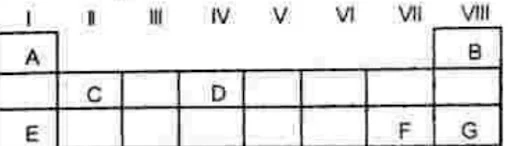
  Use the following portion of the periodic table to answer questions 1 to 3


1. Which of the letters indicate elements which exist as diatomic gases.
a).  B and G
b).  A and  F
c).  C and A
d).  A and E

2. Which of the letters represents an alkaline earth metal?
a).  F
b).  E
c).  D
d).  C

3. Which of the following pairs of letters denotes elements containing the same number of electrons in their outermost shells?
a).  C and D
b).  E and F
c).  B and G
d). A and B

4. An element X has electronic configuration 1s22s22p63s23p64s2. To which group of the periodic table does X belong?

(a). I   (b). II           (c). III           (d). IV


5. Which of the following sets of elements is arranged in order of increasing first ionization energy?

a). 11Na, 3Li, 19K, 37Rb

b). 37Rb, 19K, 3Li, 11Na

c).  3Li, 19K, 11Na, 37Rb

d). 37Rb, 19K, 11Na, 3Li


6. Elements which belongs to the same group in the periodic table are characterized by
a). difference of +1 in the oxidation numbers of successive members 
b). Presence of the same number of outermost electrons I the respective atoms
c). difference of 14 atomic mass units between successive members 
d). presence of the same number of electron shells in the respective atoms.


7. Which of the following electronic configuration represents that of a noble gas 
a). 2,8,8,2
b). 2,8,2
c). 2,8
d). 2,6

8. Which of the following pairs of species contains the same number of electrons [ 6C, 8O, 10Ne, 11Na, 12Mg 13Al, 17Cl]

a). Mg2+ and Al3+

b). Cl- and Ne

c). Na+ and Mg

d). C and Cl-


9. Which of the following statements about rare gases are correct? 

I. Their outermost shells are fully filled.    II. They are generally unreactive.    III. Their outermost shells are partially filled.    IV. They lone pairs of electrons in their outermost shell.

a).  I and II only 

b). II and III only

c). I, II and III only

d). I, II, III and IV


10. How many electrons are in the ion F- ? [199F]

a). 8      (b) 9      (c). 10      (d) 19

11. Which of the following of properties of elements generally increase down a group in the periodic table?
a). Electron affinity 
b). Electronegativity
c). Ionic radius 
d). Ionization energy

12. In which of the following atoms is the ionic radius larger than the atomic radius?        [11Na, 12Mg, 13Al, 17Cl]

a). Aluminum

b). Chlorine

c). Magnesium

d). Sodium

13. Which of the following properties is characteristics of the halogens?

a). Ability to accept electrons readily.

b). Ability to donate electrons readily.

c). Ability to form basic oxides. 

d). Formation of coloured compounds.

14. 


THEORY QUESTIONS 

1. The electronic configuration of five elements represented by the letters P, Q, R, S and T are indicated below

P --- 1s22s22p2

Q --- 1s22s22p4

R --- 1s22s2p6

S --- 1s22s22p63s2

T --- 1s22s22p63s23p5

 Without identifying the elements, state which of them

i).  Belongs to group VI in the periodic table

ii).  Is strongly metallic in character

iii).  Readily ionizes by gaining one electron

iv).  Contains two unpaired electrons in the ground state atom.

v).   Readily loses two electrons during chemical bonding

vi).  Does not participate readily in chemical reactions

vii).   Is an s-block element

bi). Copy and complete the table below as appropriate

Particle

Number of Protons

Number of Electrons

Number of Neutrons

11H

1

1

2713Al3+

168O

8

ii). Give the reason why atomic radius increases down a group in the periodic table but decreases from left to right.

iii). State three properties of transition element. [waec]


2. The electronic configuration of atoms of elements A, B, C and D are given as follows

a). 1s22s22p2

b). 1s22s1

c).  1s22s22p6

d). 1s22s22p1

ai.  Arrange the elements in order of increasing atomic size, giving reason

ii).  State which of the elements

  I. is divalent 

II. Contains atom with two unpaired electrons in the ground state.

III). Readily loses one electron from its atom during chemical bonding

IV)  Belongs to group III in the Periodic Table.


2(a)(i). List three properties of elements which increases generally across a period in the periodic table. 

(ii). Explain briefly why there is general increase on the first ionization energies of the elements across the period in the periodic table